Showing posts with label KtL. Show all posts
Tuesday, November 17, 2015
The Future
I think the future media landscape will be more of the same, just bigger. Many channels for information coming from a few main sources with plenty of misinformation thrown in thanks to the social and interactive nature of the internet. I'm not as interested in how we will consume media at that time as much as what media we will be consuming. The fewer gatekeepers we have in media and the more voracious the "i want it NOW" news cycle, the easier it is to get the wrong information and especially to signal-boost it. But maybe, in 10 years, our need to avoid anything that offends us will have created even smaller online communities where selective exposure becomes our own personal gatekeeper and the accuracy of the media is no longer as important as to whether we agree with it or not. Or whether it entertains us.
We'll still have newspapers, though. We'll still have TV news and the radio and all the things people think are going away. Maybe we've added something else. Maybe we all have google glass or cochlear implants that whisper the news directly into our brain. Maybe we have little screens on our shoes so we can send messages and still see where we are going.
Tuesday, November 10, 2015
Algorithmic
I thought the reading this week was interesting especially in how it contrasted the author's idea of "professional journalism" where the audience is rarely thought of to "algorithmic journalism" where the opposite is true. I also liked how the author made sure to recognize that the relationship can too easily be oversimplified, which i think is often very tempting to do. It's good to recognize the advantages and new abilities that big data and technology gives us, but i think the author is saying we need to continue to put a critical eye to it and not get swept away in the wave of newness.
Tuesday, November 3, 2015
Don't track me, bro
The topics raised by the paper were very interesting after just reading through the two articles on Facebook's studies. A lot of what the researchers wrote involved how much power the audience now has in agenda-setting, and how journalists need to understand they are no longer passive. This thought is reinforced by the two articles on Facebook where we saw audience posts manipulated to successfully influence other users.
To me, this just shows how important it continues to be that journalists not get swept up in audience-driven editorial judgement because enough of that is happening in the social media world already. The authors cite Barger and Barney saying “the market requires giving the public what it wants; democracy requires giving the public what it needs” (2004) and I think it's crucial for journalists to remember that they are not exclusively market-driven.
Of course, privacy issues are also a big concern in the first two articles, as big data is collected and then used to manipulate the public unknowingly. It certainly reinforces how important it is to have trained professional researchers and journalists who know the ethics of what they do.
To me, this just shows how important it continues to be that journalists not get swept up in audience-driven editorial judgement because enough of that is happening in the social media world already. The authors cite Barger and Barney saying “the market requires giving the public what it wants; democracy requires giving the public what it needs” (2004) and I think it's crucial for journalists to remember that they are not exclusively market-driven.
Of course, privacy issues are also a big concern in the first two articles, as big data is collected and then used to manipulate the public unknowingly. It certainly reinforces how important it is to have trained professional researchers and journalists who know the ethics of what they do.
Friday, October 30, 2015
"Results are in: A cleaner webpage design equals more engaged readers"
Since we were just talking about design vs content, i thought this recent study was relevant: http://www.rjionline.org/blog/results-are-cleaner-webpage-design-equals-more-engaged-readers
Monday, October 26, 2015
"Information wants to be free. Information also wants to be expensive … That tension will not go away." (Anderson 2008)
I've paid a lot of attention over the last several years to the model of online news, hoping that a clear leader in monetization would emerge in the same way that the iTunes store brought change in how most obtained their digital music. The chapter slightly depressed me because it started out strong by comparing the two newspapers but then failed to really address how the rest of the chapter could apply to news. Other than implying "if you started free you're good. if you didn't start free, sucks to be you." The author did a lot to talk about the gap between free and charging ANYthing, which i found very interesting. I never thought of the Penny Gap that way before, and how even a financial commitment of $0.01 is enough to change someone's mindset.
Comparing the chapter to the paywall data, it appears as if most people are still willing to "pay themselves less than minimum wage" to find their content elsewhere. The New York Times and Wall Street Journal have a M-F average circulation of more than 2 million yet only ~700,000 behind the paywall. I'd love to see a comparison of how many metered clicks the NY Times gets versus paid clicks. What's the falloff after the 10 free monthly views are reached? Do people pay or do they just open it in another browser or in an incognito browser to trick the metering code?
----
In a funny turn, i just opened an email and this ad was at the bottom:
I've paid a lot of attention over the last several years to the model of online news, hoping that a clear leader in monetization would emerge in the same way that the iTunes store brought change in how most obtained their digital music. The chapter slightly depressed me because it started out strong by comparing the two newspapers but then failed to really address how the rest of the chapter could apply to news. Other than implying "if you started free you're good. if you didn't start free, sucks to be you." The author did a lot to talk about the gap between free and charging ANYthing, which i found very interesting. I never thought of the Penny Gap that way before, and how even a financial commitment of $0.01 is enough to change someone's mindset.
Comparing the chapter to the paywall data, it appears as if most people are still willing to "pay themselves less than minimum wage" to find their content elsewhere. The New York Times and Wall Street Journal have a M-F average circulation of more than 2 million yet only ~700,000 behind the paywall. I'd love to see a comparison of how many metered clicks the NY Times gets versus paid clicks. What's the falloff after the 10 free monthly views are reached? Do people pay or do they just open it in another browser or in an incognito browser to trick the metering code?
----
In a funny turn, i just opened an email and this ad was at the bottom:
Monday, October 12, 2015
Twitter, huh
I think the biggest thing that stood out this week was how not only is Facebook and Twitter use plateauing, but how only 23% of adults say they are on Twitter! It was a good reminder that you can't just generalize based on experience because i would not have guessed that few people were using Twitter. It also got me wondering why so much interest seems to be focused on the service when it doesn't have as much of a user base as ANY of the other services surveyed. Possibly because of how open it is? It's a lot easier to scrape data from Twitter than any other social network where users can close down their data. I like what Krishnan brought up about the actual content of the news tweets, as many of them could possibly just be tweeting the same story over and over during the day to drum up interest (and Twitter users are encouraged to do this).
Tuesday, October 6, 2015
Google Trends
Thought this was interesting: Searches for University of Texas football, off to a pretty horrible start, is currently at 95, second only to when they won the Rose Bowl in January 2006. The annual peaks in September can be expected as that's when college football season kicks off, but I thought it was interesting to see how heavily it's being currently talked about.
PAST that, look at what happens when you strip out international audiences and focus only on the U.S.
Monday, October 5, 2015
Readings: Big Data
I read the Wired article first and got really depressed until I got to the Gonzales paper. I tend to agree with Gonzales more on Big Data, in that yes data tracking supersedes some of our previous methods but that it is still important to have human researchers that can provide context. In particular:
Only when the data are assembled in the right way, by focusing on the signal and disregarding the noise, can we build a story that makes substantive sense.Anderson doesn't agree for the necessity of theory and models to help explain data but I still side with Gonzales that there needs to be a subjective approach for us to truly understand the data especially when it comes to Social Science. Even in the hard sciences, I don't understand Anderson's example of the research "discovering" new species that he knows nothing about. What is the point of having "a statistical blip - A unique sequence that, being unlike any other sequence in the database, must represent a new species?" I would imagine one would need to know the details and not just be satisfied with a vague statistic that there probably is something. Did we send a rover to Mars to look for water or were we satisfied with the statistical probability that there would be water? It may not be completely related, but I saw an interesting article last week about the use of "small data," mainly in content-based apps like Netflix and Tinder. The author talks about how we can't handle large deluges of data and instead respond better to "card-based" types of apps where we're presented with a series of simple information.
Monday, September 28, 2015
Readings for Sept. 29
From the three readings, I believe the three main takeaways for modern audience advertising are:
1- Dig deeply into defining your audience using the advanced user data available.
The book chapter had a lot of emphasis on how specific an advertiser can target users, even to the level of uploading a customer list and having Facebook match it with their Facebook profiles. As we talked about in class, it can even use cookies to target "website abandoners" and generate ad content based on what they were looking at or considering. I found it interesting how he pointed out that our "cultural comfort" with Facebook's data mining has changed over the years as we find it more and more acceptable (well, mostly).
2- Look past "the click" as a measure of success and instead focus on engagement from cognitive, emotional and physical levels.
The white paper took some of the chapter and updated it along with adding to the idea that a successful digital ad campaign should be measured in more than just a "click." I liked the model of measuring cognitive, emotional and physical engagement. To me, it appears to try and strip away the distractions of technology and return to the roots of what makes an advertising campaign successful. I feel like sometimes we get so wrapped up in the shiny new gadget that we forget the fundamentals. These metrics apply good principals to new technology.
3- Seek users on the growing mobile platforms.
As hinted briefly in the book chapter from 2013, mobile is a growing area of audience participation that is becoming more and more important for advertisers to remember in their planning. While the fact sheet only shows 37% of digital advertising spending was mobile in 2014, it's up 12% from 2013. I think it's interesting to note how much Facebook's mobile display ad revenue grew, and feel that the book author could likely add an entire chapter on mobile advertising (with the same caveat that it will probably be out of date before it even hits the printer).
1- Dig deeply into defining your audience using the advanced user data available.
The book chapter had a lot of emphasis on how specific an advertiser can target users, even to the level of uploading a customer list and having Facebook match it with their Facebook profiles. As we talked about in class, it can even use cookies to target "website abandoners" and generate ad content based on what they were looking at or considering. I found it interesting how he pointed out that our "cultural comfort" with Facebook's data mining has changed over the years as we find it more and more acceptable (well, mostly).
2- Look past "the click" as a measure of success and instead focus on engagement from cognitive, emotional and physical levels.
The white paper took some of the chapter and updated it along with adding to the idea that a successful digital ad campaign should be measured in more than just a "click." I liked the model of measuring cognitive, emotional and physical engagement. To me, it appears to try and strip away the distractions of technology and return to the roots of what makes an advertising campaign successful. I feel like sometimes we get so wrapped up in the shiny new gadget that we forget the fundamentals. These metrics apply good principals to new technology.
3- Seek users on the growing mobile platforms.
As hinted briefly in the book chapter from 2013, mobile is a growing area of audience participation that is becoming more and more important for advertisers to remember in their planning. While the fact sheet only shows 37% of digital advertising spending was mobile in 2014, it's up 12% from 2013. I think it's interesting to note how much Facebook's mobile display ad revenue grew, and feel that the book author could likely add an entire chapter on mobile advertising (with the same caveat that it will probably be out of date before it even hits the printer).
Monday, September 21, 2015
Attention on web sites
From our two readings this week, two things jumped out.
First, that from what Pew was focusing on, they seem to want to add either a new level of audience attention or an entirely different slice by looking at whether the user is desktop or mobile- they certainly spent a lot of time on that information.
Second, the popularity of the Huffington Post shot up from the "Human Bandwidth" study where it was on the low end of the spectrum to being fourth overall in the Pew findings at 100 million unique visitors. The TV sites listed in the study such as CNN, NBC and CBS retained high rankings, growing from 20 million to 101, 101 and 84 million respectively.
I like the idea of collective metrics as a way to not only gain a deeper understanding of the audience but to also create strategic plans for growth and advertising.
First, that from what Pew was focusing on, they seem to want to add either a new level of audience attention or an entirely different slice by looking at whether the user is desktop or mobile- they certainly spent a lot of time on that information.
Second, the popularity of the Huffington Post shot up from the "Human Bandwidth" study where it was on the low end of the spectrum to being fourth overall in the Pew findings at 100 million unique visitors. The TV sites listed in the study such as CNN, NBC and CBS retained high rankings, growing from 20 million to 101, 101 and 84 million respectively.
I like the idea of collective metrics as a way to not only gain a deeper understanding of the audience but to also create strategic plans for growth and advertising.
Potential topics
I have a few ideas for my audience topic, but definitely need to further develop them. I'm having trouble figuring out just how to frame things.
Photographers in print vs instagram
I'd like to look at photo selection on what's printed versus what the photojournalist posts to their personal account. I follow a few music and sports photographers on instagram and got to thinking about it recently. Do they post the same photos that were published or do they try and offer a different look for their personal social audience? Some of it might be motivated by contractual obligations to the organization they shoot for but there also might be other factors at play like knowing what type of photo will get the most likes.
Comments Section
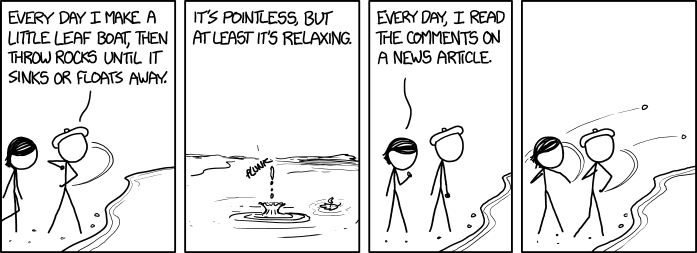
I'm interested in the gutter that can be the comments section, on a news story or even on a Facebook post on an official news Page. Mainly in whatever the gratification one gets from making a post versus the actual impact of the comment. Or possibly comparing comments on a story versus on the story as it was posted to Facebook. This might be interesting for the sites that killed story comments but still have an active Facebook presence. Did their Facebook comments increase? Decrease? Does it even matter?
Snapchat Discover
Snapchat has rolled out a channel service that lets media publish daily stories for all to watch. Comedy Central recently started a Snapchat-exclusive "show" even. I'm curious what the adoption and viewership rate is. Are Snapchat users watching this content? Some of it is able to be interacted with and re-posted but it still seems like a limited audience. Is this just advertisers going to where the users are or is the Snapchat Discover platform a viable addition to how we create/consume media? Further, the "live" stories allow users to contribute content to themed stories such as an event, city or university. Some of the live stories now include inserted ads but they can be skipped just as easily as the snaps themselves. A recent story included information showing how quickly users were passing over the ads, which makes me question the effectiveness:
Emoji in news
After recently becoming enthralled with the Emoji Tracker, i became curious about the adoption of them. Photos, videos, hashtags and emoji are four major ways to add more than basic text to a tweet. In my basic and limited searching, it appears that news organizations on twitter are using the first three but haven't really adopted emoji yet. Why? I can think of a few reasons. I'd like to dive into that a little further perhaps.
Photographers in print vs instagram
I'd like to look at photo selection on what's printed versus what the photojournalist posts to their personal account. I follow a few music and sports photographers on instagram and got to thinking about it recently. Do they post the same photos that were published or do they try and offer a different look for their personal social audience? Some of it might be motivated by contractual obligations to the organization they shoot for but there also might be other factors at play like knowing what type of photo will get the most likes.
Comments Section
I'm interested in the gutter that can be the comments section, on a news story or even on a Facebook post on an official news Page. Mainly in whatever the gratification one gets from making a post versus the actual impact of the comment. Or possibly comparing comments on a story versus on the story as it was posted to Facebook. This might be interesting for the sites that killed story comments but still have an active Facebook presence. Did their Facebook comments increase? Decrease? Does it even matter?
The most comments we ever had in a single month was July of 2014, when we had some 68,000 comments. That sounds like a lot. But we also had 12 million unique visitors that month. When you start to look at it that way, even if every comment was created by an individual commenter — which is not the way it works; surely several of those commenters commented hundreds of times — 68,000 commenters would still be dramatically less than one percent of our total readership. http://www.niemanlab.org/2015/09/what-happened-after-7-news-sites-got-rid-of-reader-comments/
![]() |
| https://xkcd.com/1385/ |
Snapchat Discover
Snapchat has rolled out a channel service that lets media publish daily stories for all to watch. Comedy Central recently started a Snapchat-exclusive "show" even. I'm curious what the adoption and viewership rate is. Are Snapchat users watching this content? Some of it is able to be interacted with and re-posted but it still seems like a limited audience. Is this just advertisers going to where the users are or is the Snapchat Discover platform a viable addition to how we create/consume media? Further, the "live" stories allow users to contribute content to themed stories such as an event, city or university. Some of the live stories now include inserted ads but they can be skipped just as easily as the snaps themselves. A recent story included information showing how quickly users were passing over the ads, which makes me question the effectiveness:
After recently becoming enthralled with the Emoji Tracker, i became curious about the adoption of them. Photos, videos, hashtags and emoji are four major ways to add more than basic text to a tweet. In my basic and limited searching, it appears that news organizations on twitter are using the first three but haven't really adopted emoji yet. Why? I can think of a few reasons. I'd like to dive into that a little further perhaps.
Monday, September 14, 2015
Response to Webster Ch. 4 and McQuail Ch. 4
The contrast between the two chapters was very interesting, as McQuail explained audience measurement in a time when social media was young and Webster came in to apply those principals to the modern day. I loved when McQuail said in his conclusion that (emphasis added) "With all the developments of research technique, there can never be more than a very approximate estimate of who was (or is being) reached, where, and under what circumstances and in what state of mind," because I actively disagreed but then after reading Webster's thoughts found myself aligning closer with the statement. Initially, I thought that with all the resources for data collection we have today of COURSE we can get more than an approximate estimate of our audience.
Webster made me think more about overgeneralization of data and audience information, especially when you look at how interactive things are today. Popularity and Personalization Bias are the two things that made me rethink my initial argument. When Webster wrote how "predications about social activity can affect the thing they are predicting" (p. 93) I realized just how complex new media audience measurement can be. I used to be a fan of the "most read" lists on news web sites but now see how they can loop through audience herding. Should news sites take those features off to encourage users to find their own news of interest? Personalization Bias seems like just a modern but veiled version of the celebrity endorser, and makes me question the metrics used to show us what is trending.
These chapters have got me thinking a lot more about how deep audience measurement really goes and how less organic it can be versus what i thought it was. Audience fragmentation, overgeneralization and popularity/personalization bias all have me leaning much closer to agreeing that we won't likely be able to obtain more than the approximate audience estimate that McQuail described.
Webster made me think more about overgeneralization of data and audience information, especially when you look at how interactive things are today. Popularity and Personalization Bias are the two things that made me rethink my initial argument. When Webster wrote how "predications about social activity can affect the thing they are predicting" (p. 93) I realized just how complex new media audience measurement can be. I used to be a fan of the "most read" lists on news web sites but now see how they can loop through audience herding. Should news sites take those features off to encourage users to find their own news of interest? Personalization Bias seems like just a modern but veiled version of the celebrity endorser, and makes me question the metrics used to show us what is trending.
These chapters have got me thinking a lot more about how deep audience measurement really goes and how less organic it can be versus what i thought it was. Audience fragmentation, overgeneralization and popularity/personalization bias all have me leaning much closer to agreeing that we won't likely be able to obtain more than the approximate audience estimate that McQuail described.
Wednesday, September 9, 2015
Response to Webster Ch. 2 and Lee Literature Review
These two writings further explored the fragmentation of the New Media audience and the ways in which they make media decisions in a saturated market of available content.
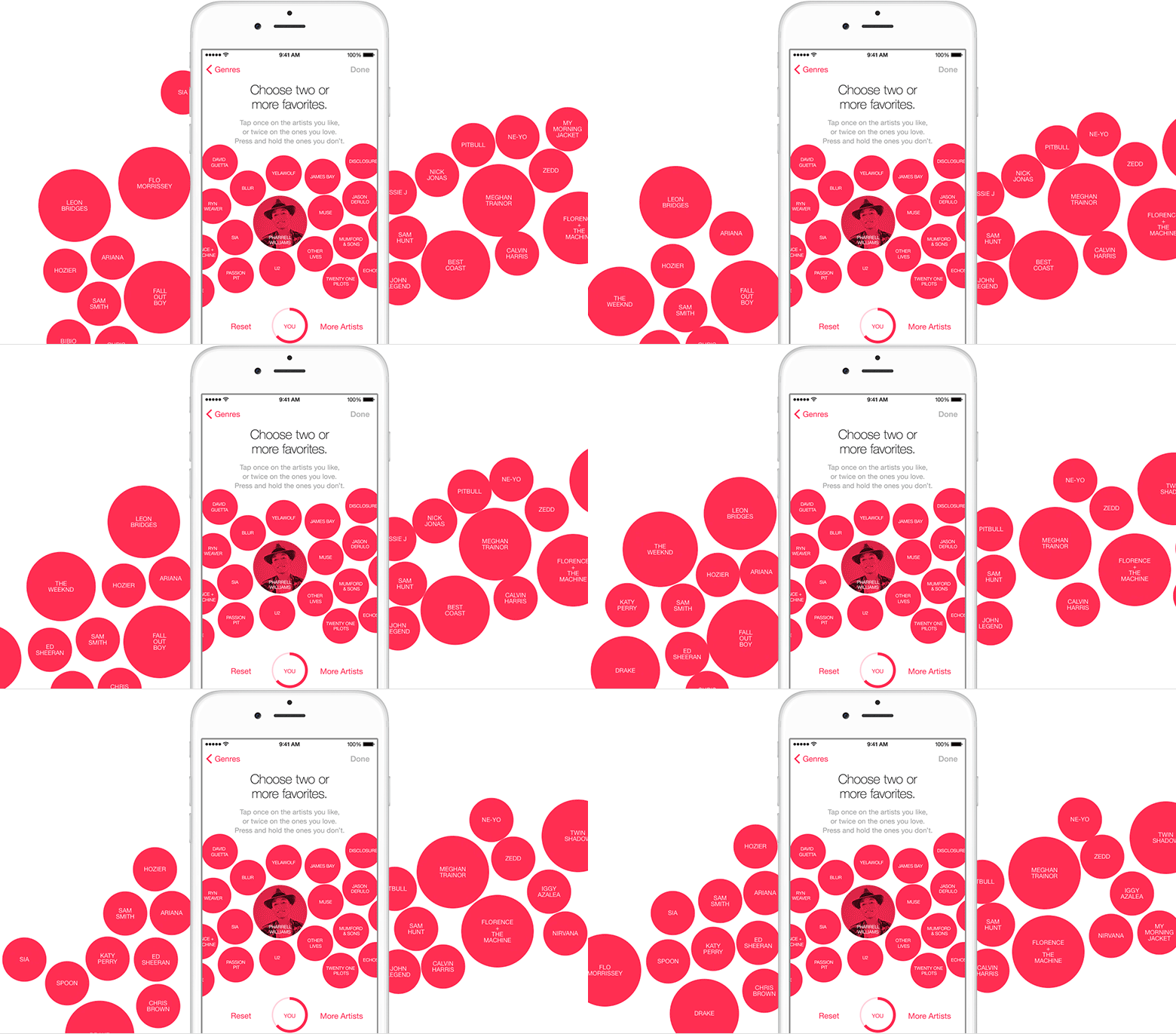
I was particularly taken with the Webster's discussion of the genre choice (p. 29) and how the audience can easier define what it doesn't like by genre than by what it does like. In so many new media networks, I feel like we are given genre tests after signing up to decide what types of content we are presented with. For example, Netflix gives us movie/TV genres and then starts to curate recommendations based on those choices. Apple Music, a newer service, presents the user with genres and artists and asks to choose what the user likes and doesn't like. In both, a dynamic choice of genre then begins to curate content. However, if Webster argues that genre choice is only best for dislikes, it seems this method may be less effective in defining what content to show a user. Both Netflix and Apple Music appear to approach a solution by also including other categories like specific artists and movie titles. Netflix once offered a million dollar prize in a contest to develop a better way of making recommendations. Lee's literature review indicated this may be a harder task than it appears due to how frequently our preferences vary, based on information, entertainment, opinion and social motivations.
Another aspect of the readings that jumped out was the idea of opinion leaders/elite influentials and how they translate to new media. The statistic Webster provided stated that opinion leaders represent just .05% of total Twitter users but command 50% of attention (p. 41). In making a piece of information go viral, it appeared that one goal is to catch the eye of an opinion leader in hopes of capturing that 50% attention of other users. In addition, I noted how much the first law of geography ("everything is related to everything else but near things are more related than distant things (p. 46)) still applies even when we have access to the entire world online. The quote from Mark Zuckerberg was especially interesting, as one would think Facebook would be where you could really see what is going on in the world, but "A squirrel dying in front of your house may be more relevant to your interests right now than people dying in Africa." (p. 46)
I was particularly taken with the Webster's discussion of the genre choice (p. 29) and how the audience can easier define what it doesn't like by genre than by what it does like. In so many new media networks, I feel like we are given genre tests after signing up to decide what types of content we are presented with. For example, Netflix gives us movie/TV genres and then starts to curate recommendations based on those choices. Apple Music, a newer service, presents the user with genres and artists and asks to choose what the user likes and doesn't like. In both, a dynamic choice of genre then begins to curate content. However, if Webster argues that genre choice is only best for dislikes, it seems this method may be less effective in defining what content to show a user. Both Netflix and Apple Music appear to approach a solution by also including other categories like specific artists and movie titles. Netflix once offered a million dollar prize in a contest to develop a better way of making recommendations. Lee's literature review indicated this may be a harder task than it appears due to how frequently our preferences vary, based on information, entertainment, opinion and social motivations.Another aspect of the readings that jumped out was the idea of opinion leaders/elite influentials and how they translate to new media. The statistic Webster provided stated that opinion leaders represent just .05% of total Twitter users but command 50% of attention (p. 41). In making a piece of information go viral, it appeared that one goal is to catch the eye of an opinion leader in hopes of capturing that 50% attention of other users. In addition, I noted how much the first law of geography ("everything is related to everything else but near things are more related than distant things (p. 46)) still applies even when we have access to the entire world online. The quote from Mark Zuckerberg was especially interesting, as one would think Facebook would be where you could really see what is going on in the world, but "A squirrel dying in front of your house may be more relevant to your interests right now than people dying in Africa." (p. 46)
Sunday, September 6, 2015
Response to Ch. 1, 8, 9 of Audience Analysis by McQuail
The book chapters served as a good introduction to the topics we will be diving into, and I especially liked how chapter eight gave us a good explanation of what was (and is) happening to the audiences and how chapter nine looked at the future of new media audiences.
In chapter eight, the concepts of audience segmentation and fragmentation made a lot of sense when applied to new media, especially in looking at the lowered "quality" of attention as the media exposure increases (pg. 132). I am intrigued by the idea that the trends give power to the audience as they reduce power of the media, especially on pages 135-136 where the author writes
I got hung up on this quality vs quantity statement and am curious whether this is truly the case when it comes to how new media content producers view their audiences. I know the number of likes and page views is important, I'm curious to what level quality is still emphasized.
A lot of what the author covered in chapter nine reminded me of an article (Questions are the new Comments) recently published where they challenge newsrooms to re-think how coverage is handled- Mainly by understand the role of the new audience and how much more active they are.
They write how the traditional passive audience doesn't get involved until the story has been completely produced and published, and their role increases as the author(s) roles decrease:
However, their suggested model takes into account this new version of an audience that McQuail writes about and puts their involvement much earlier in the process in what they call the "Public-powered story cycle" (might as well be the "Audience-powered story cycle"):
I feel this is what McQuail is referring to when he writes that new electronic media "opens up new possibilities for active relations between senders and receivers" (147). While the Public-powered story cycle could certainly have worked in traditional media, new media allows for it to occur much more easily and hopefully in a way that captures the attention of the fragmented and segmented new media audience.
In chapter eight, the concepts of audience segmentation and fragmentation made a lot of sense when applied to new media, especially in looking at the lowered "quality" of attention as the media exposure increases (pg. 132). I am intrigued by the idea that the trends give power to the audience as they reduce power of the media, especially on pages 135-136 where the author writes
The media themselves may not be so concerned about the reduced "quality" of the relationship with audiences, because the numbers are what matter most. However, for ... advocates of all kinds who want to influence behavior and opinion, the emerging media situation does represent a potential problem. Much greater ingenuity is now required to catch attention and engage an audience.
I got hung up on this quality vs quantity statement and am curious whether this is truly the case when it comes to how new media content producers view their audiences. I know the number of likes and page views is important, I'm curious to what level quality is still emphasized.
A lot of what the author covered in chapter nine reminded me of an article (Questions are the new Comments) recently published where they challenge newsrooms to re-think how coverage is handled- Mainly by understand the role of the new audience and how much more active they are.
They write how the traditional passive audience doesn't get involved until the story has been completely produced and published, and their role increases as the author(s) roles decrease:
![]() |
| https://medium.com/matter-driven-narrative/questions-are-the-new-comments-5169d0b2c66f |
![]() |
| https://medium.com/matter-driven-narrative/questions-are-the-new-comments-5169d0b2c66f |
I feel this is what McQuail is referring to when he writes that new electronic media "opens up new possibilities for active relations between senders and receivers" (147). While the Public-powered story cycle could certainly have worked in traditional media, new media allows for it to occur much more easily and hopefully in a way that captures the attention of the fragmented and segmented new media audience.
Wednesday, September 2, 2015
Week 2: Measuring our own new media audiences
My audience measurement is casual and the method depends on the platform.
For Instagram and Twitter, I use CrowdFire to track who has followed and unfollowed me. I check this approximately once a week. The main purpose is to better curate my own list of people who I follow. If a random account follows me, I usually wait a week or two before following back to see if they stay a follower or if they are just spamming random accounts to get follow-backs.
Or, if someone I follow unfollows me, I use that as a reason to remove them from my own list. It feels narcissistic at times but I want to make sure that whatever time I devote to social media is spent with people I care about and not mindless scrolling.
For Instagram and Twitter, I use CrowdFire to track who has followed and unfollowed me. I check this approximately once a week. The main purpose is to better curate my own list of people who I follow. If a random account follows me, I usually wait a week or two before following back to see if they stay a follower or if they are just spamming random accounts to get follow-backs.
Or, if someone I follow unfollows me, I use that as a reason to remove them from my own list. It feels narcissistic at times but I want to make sure that whatever time I devote to social media is spent with people I care about and not mindless scrolling.
![]() |
| CrowdFire "Recent Unfollowers" on my Instagram account |
I used to be a fairly active user of Klout but it was mainly because they would offer perks based on your social media influence. But it can be an interesting way to measure influence across all social platforms. Which audience is more engaged? According to Klout, it's my Facebook audience (51% network contribution).
![]() |
| Klout dashboard |
Finally, on my portfolio web site, I use Google Analytics to occasionally check in on my audience. It's currently a mostly-static site, so there aren't any conversion goals or expectations. The referrals have gotten spammy lately so it's hard to really place value in the analytics without refining. But it's still interesting to look at where my traffic is coming from. My photo blog has been dormant for a few months, but when it was active I would check in monthly to see where traffic was coming from.
![]() |
| Google Analytics Monthly Traffic Overview March-September 2015 |
Monday, August 31, 2015
Audience Problems
After reviewing the five key takeaways from the State of the News Media report and a few pages from the full report, I noted a few audience problems.
First, as mentioned in the very first takeaway, while more digital news traffic is coming from the mobile-using audience, they are not spending as much time on the site as desktop users. This could create a problem if advertisers ask for more than just a headcount of who is visiting the site. What good is a 60,000/day visitor count if they bail after 20 seconds? Did they even see the advertisements on the page?
Next, I was fairly surprised at the low percentage of digital adoption of newspaper readership. I was certain that more print subscribers would at least utilize a portion of the web services but more than half still claim they only read the printed product. This can cause a problem if the paper is trying to push a digital package to its advertisers or trying to justify spending on staffing or technology for the digital desk.
Finally, something that jumped out to me was the podcast section of the report. The author says "NPR reports that downloads of their podcasts were up 41% in 2014." However, I want to know what that percentage would be without the immensely-popular Serial podcast (See http://www.wsj.com/articles/serial-podcast-catches-fire-1415921853). The audience problem I see with their statistic is how many of that 41% came on board solely for Serial and are now back to their non-podcast-listening lives? Or, what was the adoption rate thanks to the popularity of the podcast?
First, as mentioned in the very first takeaway, while more digital news traffic is coming from the mobile-using audience, they are not spending as much time on the site as desktop users. This could create a problem if advertisers ask for more than just a headcount of who is visiting the site. What good is a 60,000/day visitor count if they bail after 20 seconds? Did they even see the advertisements on the page?
| http://www.journalism.org/2015/04/29/newspapers-fact-sheet/ |
Finally, something that jumped out to me was the podcast section of the report. The author says "NPR reports that downloads of their podcasts were up 41% in 2014." However, I want to know what that percentage would be without the immensely-popular Serial podcast (See http://www.wsj.com/articles/serial-podcast-catches-fire-1415921853). The audience problem I see with their statistic is how many of that 41% came on board solely for Serial and are now back to their non-podcast-listening lives? Or, what was the adoption rate thanks to the popularity of the podcast?
Subscribe to:
Posts (Atom)